Services
We offer specialized consulting, monitoring, and analysis services related to space weather impacts, focusing on protecting sensitive electrical infrastructure against Geomagnetically Induced Currents (GICs). With extensive experience in analyzing and processing solar wind particle density and magnetic field data, as well as monitoring magnetic fields in power transmission networks, we develop precise solutions for real-time detection and monitoring of space weather variations and their local system impacts. Using advanced analysis techniques, we design predictive modeling tools to prepare industrial infrastructure for critical events and minimize risks of disruptions in large companies' power grids and other sensitive systems.
What is Space Weather?
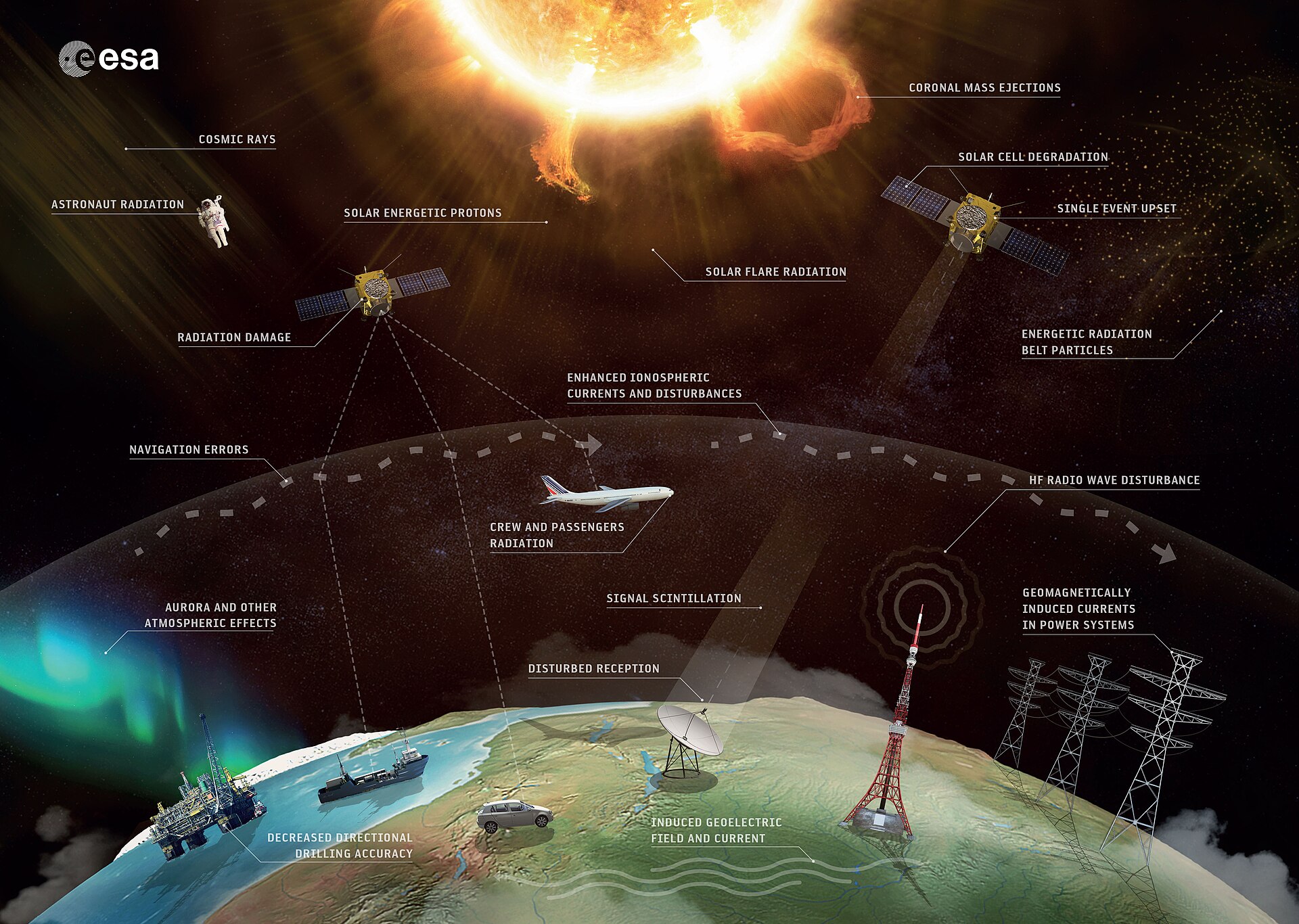
Space weather is a branch of space physics and astrophysics that focuses on studying interplanetary conditions in the solar system. The Sun constantly emits particles and magnetic fields in all directions. However, solar explosions accelerate these particles. Earth's magnetic field (magnetosphere) acts as a shield protecting us from these particles. Nevertheless, the magnetosphere's movement perturbs conditions chaotically, enabling energy transfer to lower altitudes, which can impact our technology.
With humanity's growing dependence on technology, such as GPS satellites, communications, the internet, and power grids, society has become increasingly vulnerable to the Sun's effects on Earth's magnetic field.
What Are the Risks Associated with GICs?
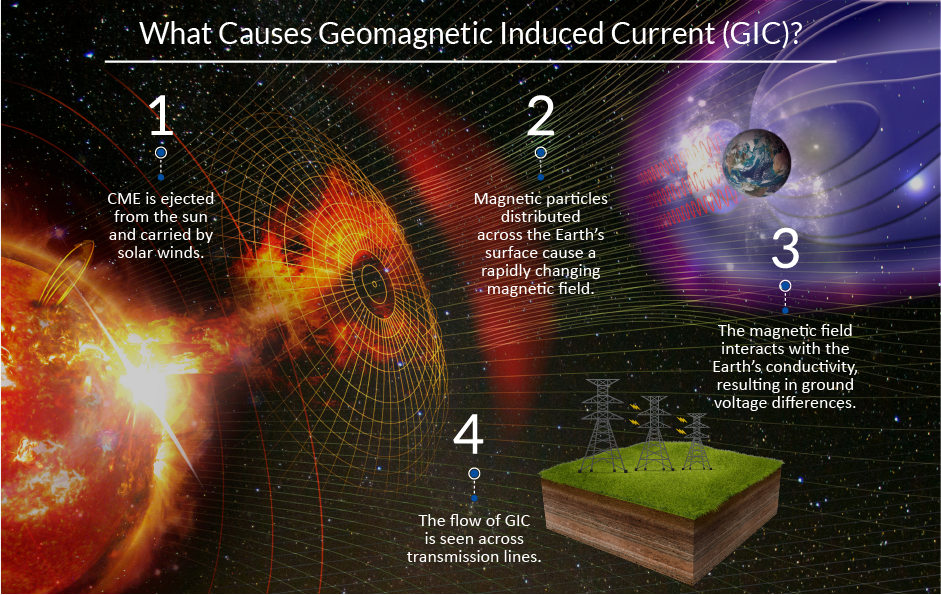
Geomagnetically Induced Currents (GICs): GICs are electric currents induced in long conductors, such as power transmission lines, due to Earth's magnetic field variations during events like geomagnetic storms. These variations generate electric fields on Earth's surface, inducing currents in conductive materials. GICs can cause direct current flows in AC power grids, saturating transformer cores. This leads to excessive heating and potential transformer damage, risking electrical distribution interruptions and negatively impacting productivity and critical infrastructure.
The effects and damages of GICs in the industry can be mitigated through adequate monitoring of space weather and local magnetic field observations. Space weather monitoring involves analyzing solar and solar wind data obtained via satellite missions, typically provided by NASA. However, GICs heavily depend on local magnetic field variations, necessitating local monitoring. Surface stations measuring real-time magnetic fields are essential for this purpose.
In addition to GICs, satellites are susceptible to damage from electromagnetic and particle radiation. While electromagnetic radiation originates from the Sun, particle radiation can come from the Sun and the Van Allen radiation belts. These are often called "killer electrons," as they are recognized as major threats to both satellites and astronauts.